

Cristina León Alfar
PhD English Literature, University of Washington, 1997

My research interests include Early Modern English drama, particularly Shakespeare, and the intersections between literature, culture, gender, law, and politics. I teach Shakespeare, late 16th and early 17th century English drama, early modern English women writers, and feminist theory.
BOOKS:
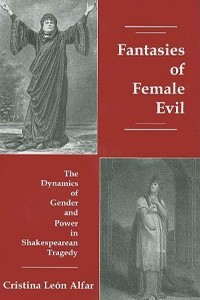
Fantasies of Female Evil: The Dynamics of Gender and Power in Shakespearean Tragedy (U of Delaware P, 2003) offers a reading of a dynamics of gender and power staged in Shakespearean tragedy that does not shrink at the violence with which women characters take power and rejects the notion that their subsequent acts of violence are transgressions of proper femininity. In fact, the notion of both proper and improper forms of femininity are held fundamentally in question throughout this study. Thus, the tragedies reject a phantasmatics of feminine identity, exorcise binaries of good and evil, and instead focus on the cultural dynamics of gender and power which both narrowed and expanded women’s roles.
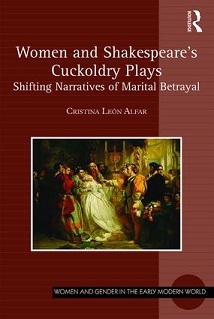
My second book, Women and Shakespeare’s Cuckoldry Plays: Shifting Narratives of Marital Betrayal (Routledge, 2017), focuses on the dramatic and rhetorical work of women’s defenses against men’s accusations of adultery. Women reject men’s stories by occupying a position of simultaneous action and honor, so that the plays stage a structure of accusation and defense that unravels the authority of husbands to make and unmake wives. Women’s active and voluble counter narratives of virtue and obedience, fidelity and love, work loose the fabric of masculine privileges in marriage, so that the rhetoric of defense turns into a site of agency while simultaneously remaining bound to the rhetoric of the accusation. Men’s and women’s competing narratives of marital betrayal uncover the ethical and political stakes for women in men’s stories of feminine duplicity. The necessity of a response, the need to defend themselves, opens opportunities for women to alter the dramatic direction, energy, and matter of the plays. A preview of the introduction is available from Taylor and Francis. Chapter one, “Early Modern Women’s Narratives of Marital Betrayal,” is available in Routledge’s Shakespeare Studies Chapter Sampler.
In 2021, Reading Mistress Elizabeth Bourne: Marriage, Separation, and Legal Controversies, which I co-edited with Emily G. Sherwood (a former student in our department and now Director of Digital Scholarship and Studio X at University of Rochester’s River Campus Libraries), was published by Routledge. The collection of documents tells a story of Mistress Bourne’s petition for divorce, its resolution, and the ongoing dispute between Mistress Bourne and her husband about their marriage and separation, and subsequently between Mistress Bourne and Sir John Conway both for custody of her daughters and her financial security. The letters capture the contradiction between married women’s official legal limitations and the often messy and complicated avenues of redress available to them. Elizabeth’s narratives and desire for divorce challenge literary representations of patient endurance where appropriate feminine behavior restores a husband’s devotion. The Bourne case offers a unique set of documents heretofore unavailable except through the British Library, National Archives’ State Papers, and Hatfield House. Reading Mistress Elizabeth Bourne is tremendously important to early modern scholars and our knowledge about and view of women’s negotiations for legal autonomy in the sixteenth century.
NEW PROJECTS:
Currently, I am working on two projects. First, I have been asked to write an article on “Feminist Authorship Studies,” to be included in The Oxford Handbook of Shakespeare and Authorship, edited by Rory Loughnane and Will Sharpe. I plan to approach this work through Michel Foucault’s notion of the “author function” to think about a feminist ethics of authorship. Sara Ahmed’s Differences that Matter, in which she traces a path through feminism, into ethics and authorship will be crucial to my work. Second, I am planning a project on women parrhesiasts in early modern English drama. As my article, “Speaking Truth to Power as Feminist Ethics in Richard III” shows, I am interested in ethical stands taken by female characters whose acts and points of view are in some sense repulsive but also compelling in light of certain moral questions posed by their plays. Specifically, I want to think about how such stands retain an ethical force that is contradicted by other acts committed by the same characters that pose problems of interpretation or reception. I argue that early modern drama stages a parrhesiastic form of citizenship, in Foucault’s terms, that is performed by women. Speaking truth to power, women resist domestic and governmental tyranny, emerge as active citizens, and speak from a dramatic and political ethical center which, I argue, is feminist. I am developing this argument through plays such as Richard III, Measure for Measure, Titus Andronicus, The Maid’s Tragedy, and The White Devil. In large part, both projects point toward my growing desire to think about what a feminist ethics of scholarship and practice looks like.
For more details, see my website and MLA Commons page.
EDITING:
"Series Co-Editor, “Late Tudor and Stuart Drama: Gender, Performance, and Material Culture,” Medieval Institute Publications, MIP – The University Press at Kalamazoo, (with Helen Ostovich, Founding Editor, Early Theatre, Professor Emeritus, English and Cultural Studies, McMaster University). https://wmich.edu/medievalpublications/books/late-tudor-stuart-drama
SELECTED PUBLICATIONS:
Co-Editor with Emily G. Sherwood, Reading Mistress Elizabeth Bourne: Marriage, Separation, and Legal Controversies. Routledge, 2021. “The Early Modern Englishwoman, 1500-1750: Contemporary Editions” (Series Editors, Betty S. Travitsky and Anne Lake Prescott)
"Speaking Truth to Power as Feminist Ethics in Richard III." Social Research: An International Quarterly, vol. 86, no. 3, Nov. 2019, pp. 789–819.
Women and Shakespeare's Cuckoldry Plays: Shifting Narratives of Marital Betrayal. New York: Routledge, 2017. "Women and Gender in the Early Modern World."
"'Let’s Consult together': Women’s Agency and the Gossip Network in The Merry Wives of Windsor.” The Merry Wives of Windsor: New Critical Essays. Eds. Evelyn Gajowski and Phyllis Rackin. New York: Routledge, 2014. 38-50.
“‘all my hair in knots’: King Lear at the Public Theater free Shakespeare in the Park, Central Park, New York City.” Internet Shakespeare Editions, Performance Chronicle, (13 August 2014): University of Victoria, BC, Canada.
“‘Proceed in Justice’: Narratives of Marital Betrayal in The Winter’s Tale.” Justice, Women and Power in English Renaissance Drama. Eds. Andrew J. Majeski and Emily Detmer-Goebel. Madison and Teaneck, N.J.: Farleigh Dickinson UP, 2009. 46-65.
“Elizabeth Cary’s Female Trinity: Breaking Custom with Mosaic Law in The Tragedy of Mariam.” Early Modern Women: An Interdisciplinary Journal, Volume 3, (2008):61-103.
“Looking for Goneril and Regan.” Privacy, Domesticity and Women in Early Modern England. Ed. Corinne Abate. Aldershot, Hampshire, UK: Ashgate, 2003. 167-198.e 3, (2008): 61-103.
Fantasies of Female Evil: The Dynamics of Gender and Power in Shakespearean Tragedy. Newark: U of Delaware P, 2003.
“‘Blood Will Have Blood’: Power, Performance, and Lady Macbeth’s Gender Trouble.” Jx: A Journal in Culture and Criticism. 2.2 (1998): 179-207.
“King Lear’s ‘Immoral’ Daughters and the Politics of Kingship.” Exemplaria: A Journal of Theory in Medieval and Renaissance Studies. 8.2 (1996): 375-400.
“Staging the Feminine Performance of Desire: Masochism in The Maid’s Tragedy.” Papers on Language and Literature. 31.3 (1995): 313-333.