Document Actions
Current 2024 NEWS
Welcome to the Asian American Studies Program & Center at Hunter College. We are proud to offer CUNY's largest undergraduate program in AAS, recently serving 1200 students. Check out links to our recorded public events!
Students who are interested in Fall Office Hours with Deputy Director, Daniel Woo: Please schedule by appointment to meet either on Mondays, 11:30AM-1PM (via Zoom) or Fridays, 11:30AM-1PM (In-Person, 1312W or Zoom). Zoom meeting link here.
Students who are interested in Fall Office Hours with new AASP Director, Charles Tien: Please schedule by appointment to meet either on Tuesdays 2-4PM (In-Person, 1719W) or Thursdays 11AM-1PM (In-Person, 1719W or Zoom). Zoom meeting link here.
Asian American Studies is thrilled to welcome Dr. Daniel Woo, as Helen Zia Distinguished Lecturer in Asian American Studies and Deputy Director of the Asian American Studies Center! Deputy Director Woo specializes in Asian American history, Afro Asian relations, social movements, popular culture, and community ethnography.
The 2023-2024 recipients of the Asian American Studies Scholarship for AAS Minors - made possible through a generous gift from Dr. Robert E. Lee, Hunter College Class of 1965: Umar Faruque, Sadia Onamika, Nabil Shah, Mariam Siddiqui, and Amalia Sularno. The scholarship recipients stand out for their combined academic excellence and contributions to Asian American Studies and to AAPI communities in NYC.
Director Vivian Louie and a Hunter College faculty team -- Dr. Linh An, Chris Kwok and Dr. Cathlin Goulding, partnered with Dr. Khyati Joshi (Fairleigh Dickinson), Freda Lin (The Yuri Education Project), and a panel of scholars on Hidden Voices: Asian Americans and Pacific Islanders in United States History, a NYC Department of Education social studies curriculum resource and guide now available in our city’s public schools.
Please join us on Monday, October 16th at 6PM for a conversation with author Amy Yee about her brand new book, Far From the Rooftop of the World: Travels Among Tibetan Refugees on Four Continents. With an introduction by Dr. Vivian Louie, Director of Asian American Studies at Hunter College, the discussion will also be moderated by Ken Roth, Former Executive Director of Human Rights Watch, with reflections from Tsewang Rigzin, an exiled Tibetan and Former Deputy Director of The Tibet Fund, Dharamshala, India. RSVP here.
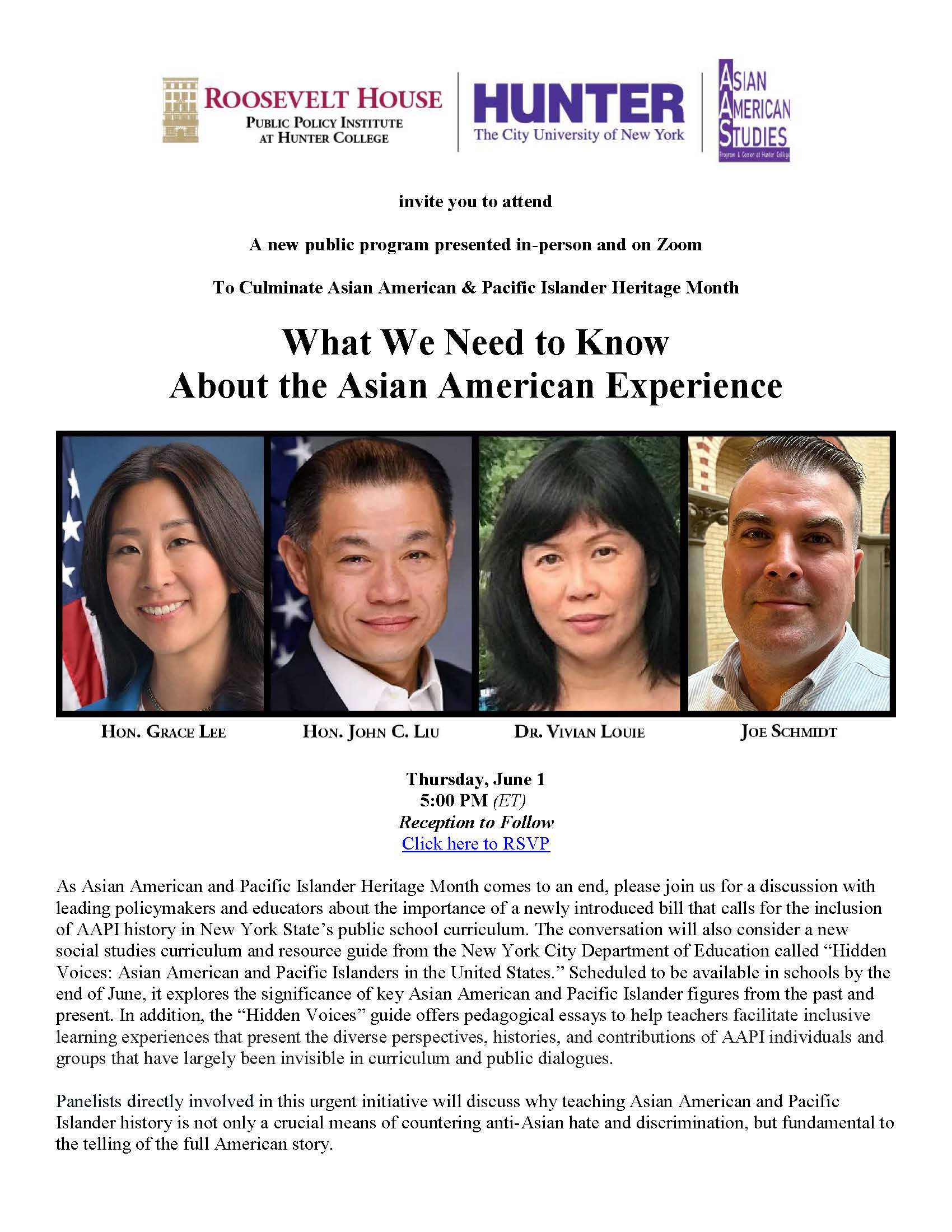
Join us for our June 1st event in-person and virtual, to culminate Asian American and Pacific Islander Heritage Month. RSVP here.
Harold Lui
The northeast corner of Walker and Centre Streets in lower Manhattan will be named "Harold Lui Way" in honor of the late Harold Lui - alumnus of Hunter College and Hunter Graduate School of Social Work, leading pioneer in NYC's Asian American, immigrant and Civil Rights communities and a kind, inspiring and dedicated advocate, leader and mentor. The dedication ceremony will be held on Thursday, November 10 at 12 noon at the northeast corner of Walker and Centre Streets. New York Times Obituary Harold Lui
Asian American Studies Awards & Acknowledgements
Congratulations to our amazing graduating seniors in Asian American Studies at Hunter College! Asian American Studies at Hunter College is also proud to announce:
The 2022-2023 Recipients of the Asian American Studies Scholarship for AAS Minors - made possible through a generous gift from Dr. Robert E. Lee, Hunter College Class of 1965: Brittany Moreno, Tahrima Chowdhury, Daniel Iskhakov, Shuhong Jiang, Soobin Park, and Michael Tamsuriyamit. The scholarship recipients stand out for their combined academic excellence and contributions to Asian American Studies and to AAPI communities in NYC.
The 2023 Prize Winners of the Asian American Studies Essay Contest Winners for Asian American Studies Minors, made possible through generous giving. First Prize: Dana Ho, Judy Dong Second Prize: Katie Chin, Samantha Yu Third Prize: Chestine Tomas. The outstanding awardees wrote about what they have learned from minoring in Asian American Studies. And congratulations to Hunter College recipients of the APIA Scholars Award, a national award, open to AANHPI undergraduate students attending any U.S. accrediated university or college: Nazmul Dewan, May Lin, Ahm Hamza, Brian Hoang, Nanzib Chowdhury, Maya Wong, Judy Dong, Pei Ying Ren, Anisa Ahmed, Joie-Ting Jing Ng, and Rithika Chowdhury.
October 18, 2022 (TUESDAY) at 2:00pm - 6:30pm EST Asian American Politics Today
Check out the video recording of this event with Director Vivian Louie, AAS professor Chris Kwok, journalist Rong Xiao Qing and political consultants Trip Yang and John Albert, New York City Council Member Sandra Ung (also a Hunter alum, Class of 1996), and The Race Epidemic Executive Producer Ron Wong. Introductions by Roosevelt House Public Policy Program Director Dr. Basil A. Smikle Jr. and Pres. Jennifer Raab. http://www.roosevelthouse.hunter.cuny.edu/events/asian-american-politics-today-paths-forward/
June 2022
Congratulations to our graduating Asian American Studies minors & recent alums! Devashish Basnet has been named a 2022 Rhodes Scholar and is only the second student in the history of Hunter College to receive a Rhodes. Read more about Basnet's journey from Nepal to the United States and his amazing accomplishments here. Mahnoor Ali has been awarded the Hunter College Asian American Studies Scholarship. In addition to Ali's academic excellence, she has done leading work for the NYC chapter of the National Asian Pacific Women's Forum, helping to create its first Urdu/Bangla Outreach Team. The AAS Undergraduate Scholarship for AASP Minors has been made possible thanks to a generous gift from Dr. Robert E. Lee, Hunter College Class of 1965. Kudos to two recent alums: Rachel Tieu has been an invaluable asset to Asian American Studies and HCAP this semester. Shakila Khan published Visuality of Violence: An Examination of Images Depicting Racialized Political Violence in the Mellon Mays Undergraduate Fellowship Journal (p 63).
Asian American Studies at Hunter College (Fall 2021)
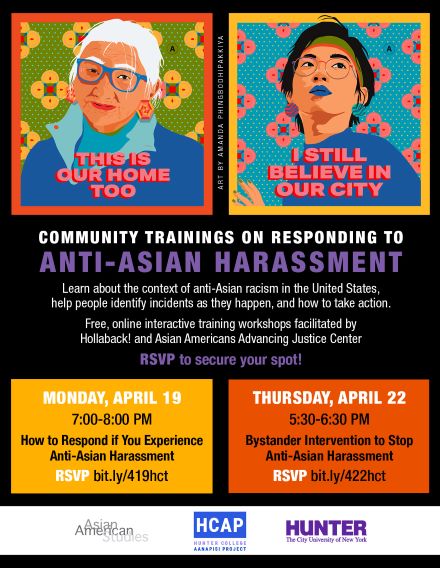
We recognize that education is more important than ever. This is especially true during these challenging times of anti-Asian hate. We highlight the work of our director, faculty affiliates, and adjunct faculty in Asian American Studies at Hunter College along with our Hunter students and alumni. We are proud to have offered two community trainings in responding to Anti-Asian harassment. See some of our recorded events.
Director, Vivian Louie
Commentary
- @nycfuture report, recommendations to intergrate and expand ethnic studies educational programming & leverage the city's rich nonprofit sector to spur interracial/ethnic dialogue.
- Asian American studies, more vital than ever: Coronavirus is a moment we should be learning.
- Asian American Studies: Telling the Story of America
Research Article
- Asian Americans and COVID-19: What We Still Need to Know about Race and Racial Exclusion in America.
Quoted In
- From racial slurs to thrown rocks, Delaware's Asian community says hate exists here, too
- Critics pounce on Meghan McCain's comments about Asian representation on 'The View'
Featured in Podcasts and Webinars
- Asian American Life for CUNY TV. Election 2021 in NYC.
- The Thought Project -- To Stop Anti-Asian Racism, First Remedy Ignorance and Nationalism -- in conversation with Hunter colleagues Manu Bhagavan (History & Human Rights Program) and Tanya Domi (Human Rights Program)
- The Pandemic's Effect on Education
- The Discriminatory Impact of COVID-19
Faculty Affiliates in Education, Social Work, Urban Policy & Planning and Sociology
- The forgotten neighborhood: how New York's Chinatown survived 9/11 to face a new crisis featuring Margaret M. Chin, co author of The 'model minority' myth hurts Asian Americans - and even leads to violence
- Stigma Is Associated With Widening Health Inequities: Challenges From the Current COVID-19 Pandemic co written by Ming-Chin Yeh
- Stare Down the White Gaze: Demystifying the "Model Minority" Stereotype - commentary by Yang Hu
- Social Work's Call to Action Against Pandemic Othering & Anti-Asian Racism, co written by Keith Chan
- The Problem with Policing Massage Workers After the Atlanta Shooting, featuring John Chin
Adjunct Faculty
- Glenn Magpantay is a 2021 Soros Equality Fellow - he will survey the history of queer Asian organizing over the past 20 years to build a sustainable and robust queer Asian movement for racial justice. He also has been honored with the "Award for Excellence in Pre-Law Advising" from the Association of American Law Schools (AALS) Section on Pre-Law Education & Admission to Law School.
- Linh An is recognized in City & State's inaugural Mental Health Power 50 list and interviewed in the Decolonizing Mental Health series.
- Chris Kwok has been named to Manhattan D.A. Elect Alvin Bragg's transition team, and is co author of A Rising Tide of Hate and Violence against Asian Americans in New York During COVID-19: Impact, Causes, Solutions
- Glenn Magpantay has been honored with the "Award for Excellence in Pre-Law Advising" from the Association of American Law Schools (AALS) Section on Pre-Law Education & Admission to Law School and is author of TIGER: A Sustainable Model for Building LGBTQ AAPI Community.
- Chris Lin's artwork is featured at the Queens Museum's Wet Networks exhibit, alongside the Museum's long-term exhibition of The Relief Map of New York City's Water Supply System; and will be featured at Wave Hill in the Bronx, as part of its winter workspace exhibit.
- Fidelito Cortes was named an Andrew W. Mellon Transformative Learning in the Humanities Faculty Fellow at CUNY in Fall 2021.
Our Alumni
- Van Tran (Class of 2004) featured in @nycfuture report, writing about expanding benefits and extending local voting rights to immigrant communities and in New report finds 169 percent surge in anti-Asian hate crimes during the first quarter.
- New report finds 169 percent surge in anti-Asian hate crimes during the first quarter -- featuring Van Tran (Class of 2004)
Our Students
For more information, see our full list of Faculty and Affiliates.
Additional Work from our Faculty and Affiliates
Higher Education and Faculty of Color
Immigrant Labor
Seo, J. Y., Chao, Y.-Y., & Strauss, S. M. (2019). Work-related symptoms, safety concerns, and health service utilization among Korean and Chinese nail salon workers in the greater New York City area.Asian Pacific Journal of Public Health, 31(3), 199-209.
Seo, J. Y., Chao, Y.-Y., Yeung, K. M., & Strauss, S. M. (2019). Factors influencing health service utilization among Asian immigrant nail salon workers in the Greater New York City area.Journal of Community Health, 44(1), 1-11.
LGBTQ
Magpantay, Glenn. TIGER: A Sustainable Model for Building LGBTQ AAPI Community, 30 Asian Amer. Pol'y Rev. 5 (2020) (Harvard J.F.K. School of Government).
Arts
Exhibitions:
Earthly Delights, Good Naked Gallery, Prospect Park, Brooklyn, NY, 2020
Hibernation, The Royal at the Royal Society of American Art, Brooklyn, NY, 2020
Choreography for an Unfamiliar Here, Trestle Gallery, Brooklyn, NY, 2021